
OUR STORY & PHILOSOPHY · EST. 2021
FROM OUR ORIGIN CAME
OUR PURPOSE.
“Never forget your people.”
THE ORIGIN
IT ALL BEGAN BY RETURNING TO THE ROOT
In 2021, one uncertain night revealed an idea that could bring together our Otomí roots, garments made from recycled materials and collaboration with artisans from our community. That is how Ojitos Negros began.
Before the brand, there was a transformation
Ojitos Negros didn’t begin as a trend, nor with the intention of building a fashion brand.
His story began years earlier, when Sergio Pedraza received a cancer diagnosis that changed the way he looked at life. After almost a year of treatment, he understood that surviving wasn’t enough: he wanted to find a purpose and build something capable of leaving a mark on other people.
That experience raised a question that would stay with him: What can I do with my story to create something valuable for others?
Some time later, his work at a solar energy company strengthened an environmental awareness that was already in him. For Sergio, the relationship with nature was not a new concept; it was part of a much deeper inheritance.
Returning to the origin
Sergio is the son of Otomí parents from San Pedro Arriba, in Temoaya, State of Mexico. He grew up closely connected to his community, to nature and to artisanal work.
Among his father’s teachings, one phrase stayed with him: “Never forget your people.” For a long time those words seemed like simple advice. Years later they would become the direction of a brand.
In 2021, in the middle of the pandemic, Sergio lost his job. Opportunities were scarce and uncertainty seemed to close every path. He looked for alternatives outside his world and even considered importing products from other countries, but no idea felt connected to his own story.
Until one night, as he wondered what to do, a phrase came to him clearly: Eco-friendly hand-embroidered tees.
In that moment he understood that the answer he was looking for didn’t have to come from somewhere else. It was in his roots.
The first stitches
Sergio contacted one of the suppliers he had met while working in the environmental sector and selected finished tees made from recycled materials. He then took the first samples to his community.
The project began with two families. Sergio gave the garments to the artisans so they could experiment with them, test the fabric and bring in their knowledge, sensibility and creativity.
When he came back and saw the first embroidery, he knew the idea could become something bigger.
It was never simply about placing a handcrafted element on a tee. Every piece was born where a lower-impact garment met a cultural identity and the hands of women who had inherited their knowledge across generations.
Over time, the project came to work with more than twenty families, mostly Otomí women artisans. In the middle of the pandemic, that collaboration also meant work and income outside the cities. That is how Ojitos Negros began.
Collaborate, don’t appropriate
From the beginning we understood that craft should not be used as decoration, nor reduced to a production cost. Artisans bring knowledge, interpretation and sensibility to every piece of embroidery. That is why we recognise them as co-authors of the pieces they take part in.
Our relationship is built on clear agreements, fair pay, mutual respect and one essential practice: we never haggle over the value of their work.
We call this philosophy Co-authorship Value. Because when a piece is the result of several hands, the recognition and the value it creates must be shared too.
What Ojitos Negros means
While searching for a name, Sergio returned once again to his mother tongue. In the Otomí language he found an expression linking the ideas of “eyes” and “black”. From that encounter came the name Ojitos Negros.
But its meaning grew alongside the brand. Eyes don’t only represent a feature shared by many people in our community; they also stand for a way of looking inward, recognising who we are and remembering where we come from.
Ojitos Negros became an invitation to return to your origin and carry it with pride.
A story between Mexico and the United States
The pandemic temporarily halted the brand’s growth. Soon after, Sergio moved to New Jersey in search of new opportunities. Ojitos Negros was paused, but never abandoned.
While Sergio worked and learned how businesses are built in the United States, he began developing other ideas. Yet something unexpected happened: Ojitos Negros pieces kept finding people who wanted them. The brand was still alive.
Sergio decided to return to the project, took pilot pieces to the United States and began sharing his story again. The community’s response confirmed that Ojitos Negros could cross borders without letting go of its roots.
Today we are a brand built between Mexico and the United States: we collaborate with artisans from our community, choose garments made from recycled materials and create designs that connect our cultural identity with the present.
Our story continues. Ojitos Negros wasn’t born to reproduce the past, nor to turn culture into a trend. It was born to give it continuity.
Every piece brings together three commitments: the value of artisanal work, a more conscious choice of materials, and the economic and creative recognition of the artisans who take part as co-authors.
Whoever chooses an Ojitos Negros garment doesn’t just wear a design. They carry a story that began in an Otomí community, found a new path in the middle of uncertainty, and today seeks to connect our roots with the world.
History changes. Our identity remains.
“A hero isn’t defined by the wounds they go through, but by the decision to get up every day.”
Sergio Pedraza
Founder of Ojitos Negros M’ODA Ecológica · Speaker on cultural identity and business with purpose.
THE OTOMÍ COMMUNITY
FACES, HANDS AND STORIES.
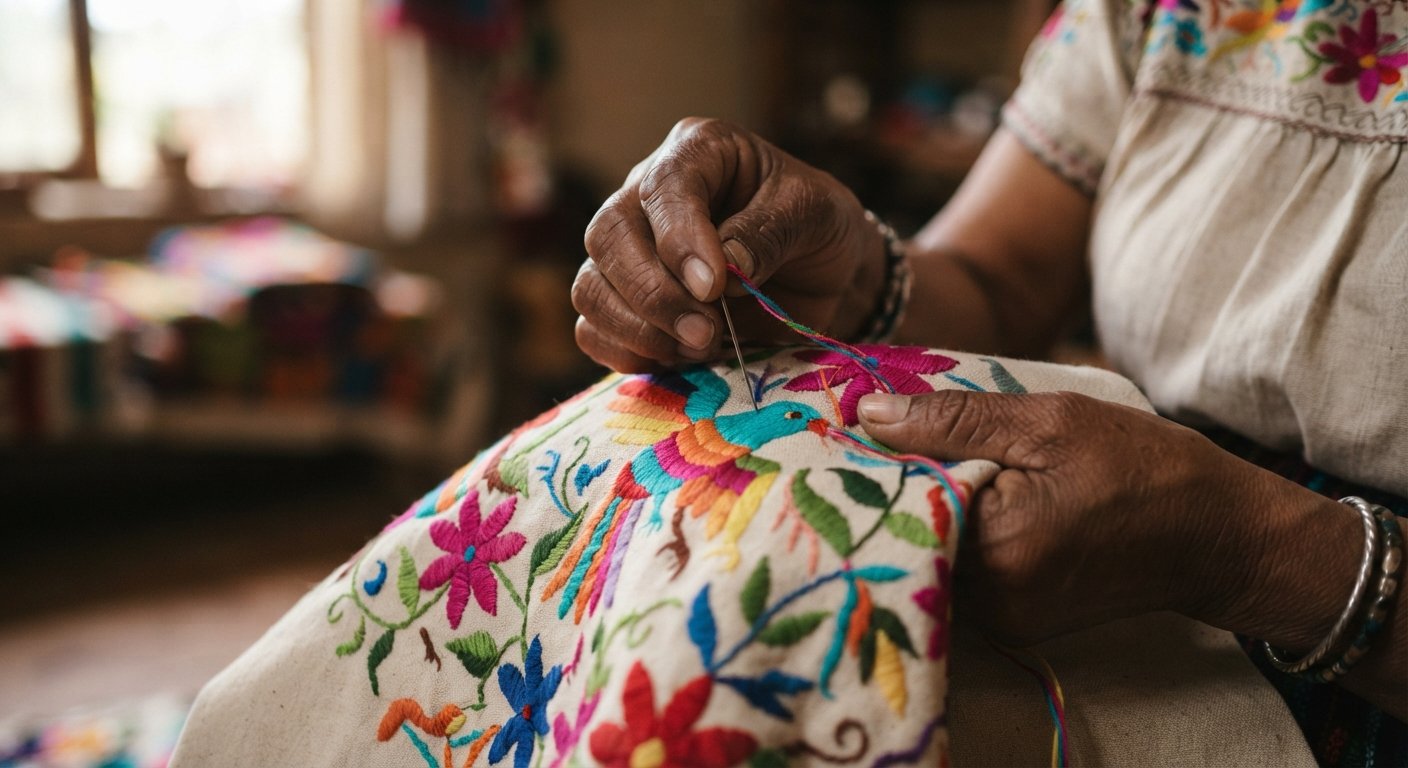
WHO THEY ARE
The Otomí people —also known as Hñähñu— are one of the oldest indigenous peoples in central Mexico. Women and men of all ages keep textile knowledge alive, passed down through generations.
They work with techniques such as Tenango embroidery, cross-stitch and the making of Otomí rugs. Each process calls for different tools, skills and timeframes. Although they use hoops to hold and tension the textile, the work is done by hand, without modern machinery.
HOW THEY WORK
Birds, deer, flowers and fretwork are part of a visual language born of the land, of memory and of imagination. Today that knowledge also makes it possible to interpret modern, contemporary and urban designs.
Every piece calls for patience, precision and sensibility. Depending on its size, technique and complexity, a piece of embroidery can take days or even weeks of meticulous work.
WHAT IT MEANS
Embroidering is not only decorating. It is turning memories, emotions and ideas into shapes and colours. Each person leaves in the piece something of what they observe, imagine or feel while creating it.
When you wear one of these pieces, you don’t only wear a design: you wear a personal expression that shares a root and carries the feeling of whoever created it.

M'ODA · B'ODA
= OJOS NEGROS
da → eyes mb’ot’i → black. We chose M’ODA for its visual and sound connection with the word for fashion. Later we discovered a deeper meaning: Ojitos Negros. Today the name honours the artisans who embroider every piece and the feature that inspired our identity.
OUR PHILOSOPHY
M’ODA WITH CULTURAL IDENTITY
We believe a garment can do more than dress you: it can express who you are, honour your origin and carry a story into the future. Our philosophy begins with a simple decision: to give value to what deserves to last.
FAST FASHION
- Mass, fast and disposable production
- Anonymous, poorly paid work
- Virgin fibres, dyes and chemicals
- Trends that expire within weeks
OUR WAY
- Short runs and processes that respect the time artisanal work takes
- Artisans with a name, a face and fair pay
- GRS-certified fabric, regenerated material
- Timeless designs that endure.
THE FABRIC · GRS CERTIFICATION
RESOURCES THAT RETURN TO THE CYCLE.
Our garments are made with textiles certified under the Global Recycled Standard: 50% recycled PET and 50% regenerated cotton. By choosing recovered materials, we help extend their useful life and reduce the need for new raw materials.
50%
RECYCLED PET
Yarn woven from recovered PET bottles.
6–12
BOTTLES · PER GARMENT
Recycled PET in every garment you wear.
~2,000 L
WATER SAVED
Per garment, compared with conventional production.

50%
REGENERATED COTTON
Natural fibre, no virgin cotton.
<10 L
WATER IN PROCESS
Throughout its entire production process.
0
ADDED CHEMICALS
No dyes, pesticides or chemicals.
WHERE WE’RE HEADING
MISSION, VISION AND VALUES
—
MISSION
To connect our story with the world through garments with cultural identity, bringing together contemporary design, recycled-content textiles and respectful collaboration with artisans.
—
VISION
To be a Mexican brand of international reference in fashion with cultural identity, recognised for connecting our roots with the present through artisanal work, environmental awareness and contemporary design.
VALUES
■
Cultural identity
We acknowledge our origin and express it through garments that connect history, culture and the present.
■
Artisanal value
We respect the knowledge, the time and the sensibility of artisans, through clear agreements, fair pay and relationships without haggling.
■
Environmental awareness
We choose recycled-content textiles to extend the life of materials that already exist and reduce the need for new raw ones.
■
Permanence
We design pieces with cultural meaning, made to outlast the seasons, to be cared for and kept.
■
Purpose
Every decision must create value for people, respect our roots and contribute positively to the environment.